
Founded in 2012 in Honolulu, the Sustainability Incubator is an impact firm taking major problems of economy and environment through the problem cycle to solutions.
Evidence, New Methods, Curricula, Policy, Updated Practices, Shared Learning.
Our diverse clients are pursuing stewardship. We focus on grounding their decisions in real world conditions in real time. They are firms of all sizes, public institutions ASEAN, UN-FAO, IOM and USDOL, and foundations Humanity United and the Freedom Fund. Our rigorous independent research is published in Nature, Science Advances, Science, PloS One, Marine Policy and featured frequently by media including the Associated Press (1,2), Financial Times (1,2), all major networks and the Washington Post, NPR, seafood media and by Oceana, the International Trade Workers Federation, Global Labor Justice, Greenpeace and podcasts like Un-romancing the Ecolabel.
Results? We’ve led social learning for stewardship in the global seafood sector:
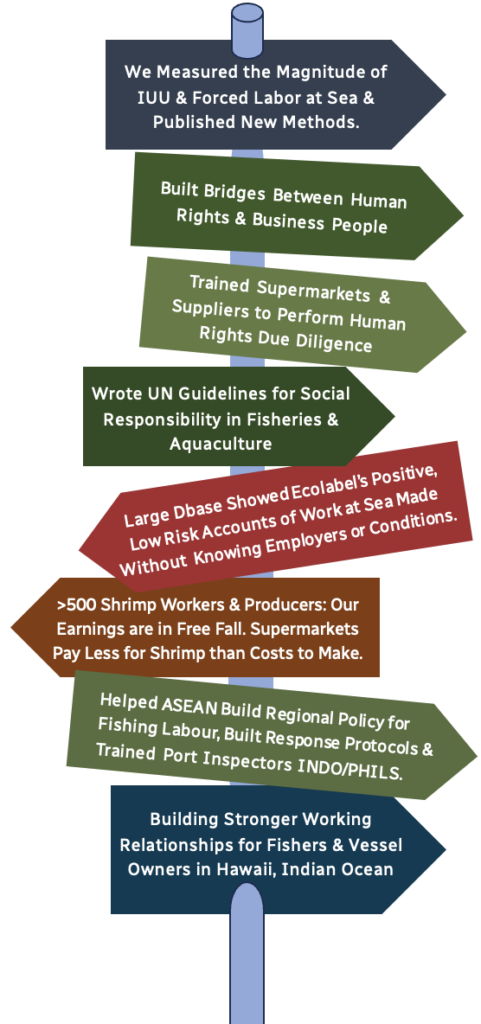
2025-26: We assisted ASEAN to develop a fishing labor policy framework for SE Asia for the first time and prepared practical adaptations for fishing fleets in the Pacific and Indian Oceans: Crew Rights Handbook/Vessel Owner Code of Conduct, training for the safe handling and release of animals caught in fishing gear. Results: New labor oversight. Stronger working relationships. Lower mortality for sea birds, turtles, sharks and threatened species.
2022-2026: We built databases of 3327 tuna vessels and >500 interviews with shrimp workers to see real world conditions in real time. Results: Our tuna findings in Nature were featured by the Financial Times and Re:Structure Lab. Our shrimp findings were featured by Associated Press, all major US networks, news outlets across Asia and sparked dialogues with 2 governments.
2015-2024: We helped build labour oversight by training (1) 80 seafood suppliers in 14 countries, (2) inspectors at 4 ports in Indonesia and the Philippines, and (3) employers in Thailand and Indonesia and by drafting global guidelines for fisheries & aquaculture for UN-FAO. Results: The curricula we developed were taken up into private and public sector mandates and port protocols and led to human trafficking rescues.
2013-16: We co-developed detection methods with Thai Labour Rights Promotion Network published in Science Advances and used to screen >500 supply chains. Results: We won the Partnership for Freedom grand prize for Labor Safe Screen. Results: Forced labor at sea and in supply chains was faced for the first time.
2011-14: We estimated the magnitude of illegal content in US seafood imports finding 20-32% on average and 70% in Thai tuna. Results: Citing our work 44x, USA struck a Presidential Task Force and began monitoring imports.

About Us
We build oversight for better decisions in real time and help our clients to develop tools for decisions by following Nobel laureate Elinor Ostrom’s design principles for successful stewardship. In short, social learning is the key to stewardship. Every organization works through relationships and has a wide array of sight lines to draw from to thrive and adapt — but might not be seeking out different perspectives or know how to see and hear people at the frontline who are seeing obstacles plainly and navigating what is changing. We work in teams by recruiting people at the frontline who are in a position to see and respond to conditions. The Sustainability Incubator is a project-based firm and we embed social learning in clients’ systems so they can collaborate to adapt.
Leadership is provided by founder Dr. Katrina Nakamura, an impact scientist, rural planner and (fmr) wharfside restaurateur.
Resources to Share
- Social Learning to Adapt to Real World Conditions:
- ASEAN-Framework for a Regional Fishing Labour Policy (endorsed by ASEAN’s 11 members states in 2026)
- Social Learning to Detect and Respond to Forced Labour at Sea:
- International Organization for Migration-Experiential Training-for-Fishing-and-Seafood-Enterprises_Thailand,
- IOM-Experiential Training-for-Fishing-and-Seafood-Enterprises-Indonesia,
- SAFE-Seas-Training & Oversight-for-Port-Inspectors-Philippines.
- SAFE-Seas-Training-Manual-for-Port-Inspectors_Indonesia.
- Recent Publications:
- Is tuna ecolabeling causing fishers more harm than good? Nature
- A Practical Take on the Duty to Uphold Rights in the Seafood Workplace. Marine Policy.
- Seeing Slavery in Seafood Supply Chains. Science Advances.
- Committing to Socially Responsible Seafood, Science.
- Social equity is key to sustainable ocean governance. Nature.
- The role of human rights in implementing socially responsible seafood. PloS One.
- Committing to socially responsible seafood. Science.
- Estimates of illegal and unreported fish in seafood imports to the USA Marine Policy.
- Op/Ed: The numbers tell the story when it comes to forced labor in seafood. Seafood Source Media.
- Performance of regional fisheries management organizations: ecosystem‐based governance of bycatch and discards, Fish and Fisheries.
- Improvements to Rapfish: a rapid evaluation technique for fisheries integrating ecological and human dimensions. Journal of Fish Biology.
- Sea turtle bycatch to fish catch ratios for differentiating Hawaii longline-caught seafood products. Marine Policy.
Contact us at the.sustainability.incubator@gmail.com. Mahalo.